Traditionally, mines rely on a fixed time approach to deal with post-blast re-entry time. This often leads to substantial delays due to the requirements for managers and safety personnel relying on hand-held gas monitors to descend into the stop blasting area to identify any potentially damaged ventilation infrastructure and measure seismic movements at the working face. This exposes valuable mine personnel to potential seismic and toxic gas risk, and often leads to significant delays in the return of the face to productive use.
In collaboration with Mine Design Technologies, Conspec is proud to announce the Post-Blast Monitoring Solution for Underground Mines to deliver innovation that Digs Deeper. Conspec has the distinct pleasure of providing a safer, more efficient solution for underground mines.
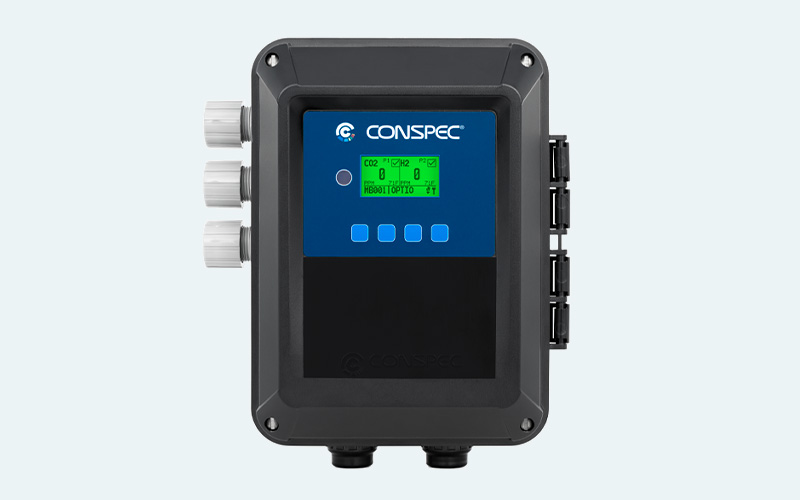
Through the selective deployment of Conspec’s Optio G/IS Gas Carbon Monoxide (CO) and Sulfur Dioxide (SO₂) Gas Monitors over existing data communications infrastructure near the blast area, Ventilation Managers can safely monitor real-time gas dissipation levels in the blasting areas post-blast. This allows Ventilation Managers to remotely monitor post-blast gas dissipation and remotely identify any damaged ventilation infrastructure. Ventilation Managers can now deploy the necessary fully equipped Repair Teams from surface to repair or replace any ducting and ventilation infrastructure without risking personnel or causing delays, therefore significantly reducing the time to return the blast face to productive use.
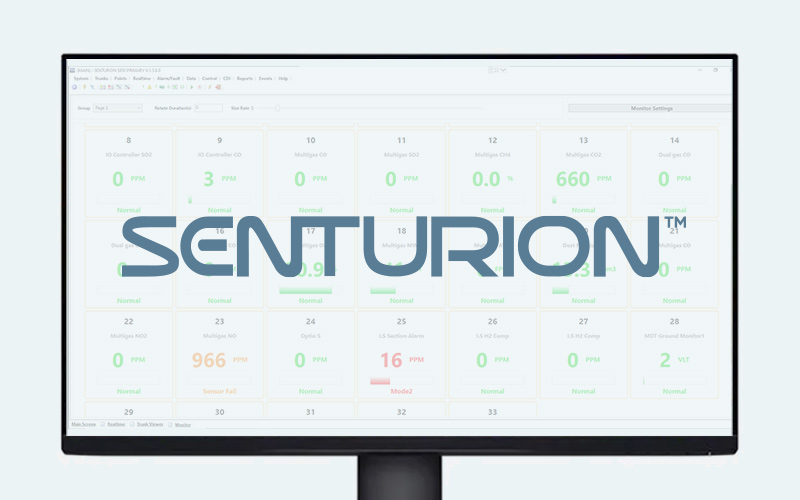
By integrating Mine Design Technology’s Smart MPBX into a Conspec Senturion Mine Wide Monitoring System using Conspec’s Optio MPBX Six Sensor Monitor, operators can use existing data-communications infrastructure such as Ethernet, POE, LTE and Leaky Feeder Data Channels without the need to install costly additional third-party data communications infrastructure. Geotechnical Managers can remotely monitor the real-time seismic movement post-blast safely from the surface, allowing them to compare the movement to historical post-blast data to best ensure safe re-entry of all underground mine personnel.
Explosion-proof multi-gas detector with wireless communication for hazardous mining environments
Supports up to 6 sensors with gateway-based relay and Modbus RTU outputs for alarm and process integration
MSHA-approved fixed multi-gas detector with wireless communication for hazardous mining and classified areas
Supports up to 6 sensors with relay, 4–20 mA, and Modbus RTU outputs for alarm and process integration
MSHA-approved fixed multi-gas detector for mining and industrial environments
Supports up to 6 sensors with relays, analog outputs, and Modbus RTU for integration
Detects over 100 gases with support for 35+ sensor types and optional remote sensing for harmful areas
Analog 4–20 mA, dry relay contacts, and Modbus RTU for seamless PLC/DCS/EMS integration
Fixed alarm horn & 10 J Xenon strobe, 115 dB(A), Type 4/4X corrosion-proof marine enclosure
Globally certified for Class I Div 1 / Zone 1 hazardous locations; 4 alarm stages, 64 selectable tones
Fixed flare horn & 10 J Xenon strobe, 117 dB(A), corrosion-proof marine enclosure
Globally certified for Class I Div 1 / Zone 1 hazardous locations; 4 alarm stages, 64 selectable tones
Fixed alarm horn & 10 J Xenon strobe, 116 dB(A), Type 4/4X marine-grade enclosure
ATEX / IECEx Zone 2 & 22; NEC/CEC CI & CII Div 2 approvals; 4 alarm stages, 64 selectable tones
Fixed, close-coupled alarm bar with LED/Xenon beacons and 116 dB(A) horn; corrosion-proof marine-grade enclosure
ATEX / IECEx Zone 2 & 22; UL / cUL listed; multi-stage alarms, integrated cable loom for quick installation