Accelerating Re-Entry Times with Real-Time Gas Detection Data
How much production time are you losing after every blast? For many underground mining operations, delayed re-entry due to uncertain gas conditions is an accepted (but costly) part of the process. In the following case study we’ll discuss how real-time gas monitoring can reduce that downtime, helping operations safely return crews to the face faster while improving overall output and efficiency.
Overcoming Post-Blast Gas Risks in Underground Mining Operations
A growing silver mining operation in northern Mexico was facing persistent challenges managing hazardous gases after blasting, making it difficult to determine when it was truly safe for miners to re-enter. Without precise, real-time gas data, teams were relying on conservative estimates.
This led to extended delays, inefficient ventilation practices, and growing concern among workers about the conditions they were returning to underground. Compounding the issue, the mine lacked consistent power infrastructure and modern communications networks in key areas, making it difficult to deploy traditional fixed gas detection systems. At the same time, the operation needed a solution quickly to avoid further production losses.
“Mining operators shouldn’t have to choose between safety and productivity,” explains Tanveer Jahir, a solutions engineer with Conspec Controls. “Without real-time gas measurements, safety personnel are forced to slow everything down; and that has a real impact on both productivity and miner confidence.”
Implementing Real-Time Gas Detection Using Existing UHF Networks
Conspec worked closely with the personnel at the mine to develop a solution engineered for the realities of underground mining; where infrastructure limitations often dictate what’s possible.
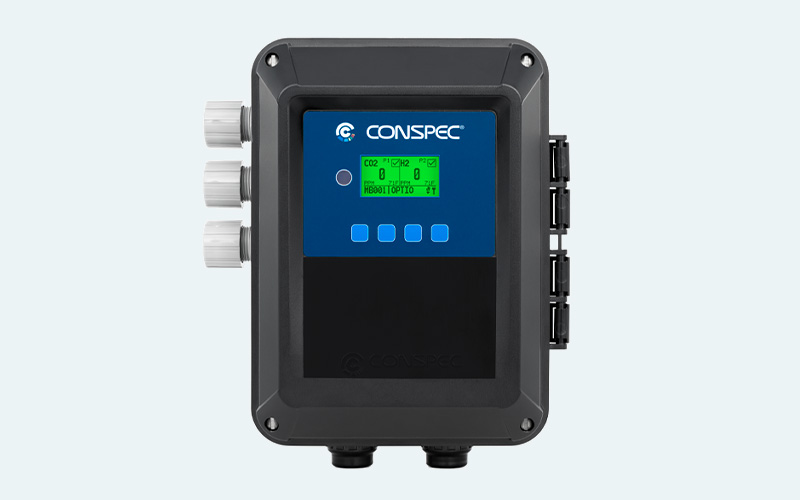
The team chose to deploy Optio G Multi-gas Monitors, a flexible gas detection system capable of operating independently of fixed power. By leveraging the mine’s existing UHF communication network, the solution was implemented quickly without the need for extensive new infrastructure.
With a battery life of up to two years and the ability to deliver continuous, real-time gas readings, the system gave operators clear visibility into post-blast conditions. This allowed them to track gas dissipation with confidence and make informed decisions about when it was safe to resume work.
“We engineered this system to fit the environment—not force the environment to fit the system,” says TJ. “That’s what allowed us to move quickly and deliver meaningful results right away.”
Improving Mine Productivity by Accelerating Safe Re-Entry
With access to real-time gas data, the operation fundamentally changed how it managed post-blast workflows. Instead of relying on fixed wait times and conservative assumptions, teams could now track gas decay as it happened—giving them the confidence to make faster, data-driven decisions about when it was safe to re-enter.
That shift had a measurable impact on production. By shortening the time between blasting and re-entry, crews were able to return to the face sooner and begin the next phase of work without unnecessary delays. Over the course of multiple blast cycles, those time savings compound—unlocking additional productive hours and increasing overall output without adding labor or equipment.
Just as importantly, those gains didn’t come at the expense of safety. Real-time monitoring ensured that faster re-entry decisions were backed by accurate data, reducing the risk of exposure to hazardous gases and reinforcing compliance with safety standards. Workers gained confidence knowing that conditions were continuously monitored and validated—not estimated.
Ventilation strategies also improved. With empirical data guiding airflow decisions, the operation was able to reduce over-ventilation and better target resources where they were needed most. This led to lower energy consumption and reduced operating costs, further strengthening the mine’s bottom line.
“Every minute counts after a blast,” says Jahir. “When you can safely get crews back to the face sooner, you’re not just improving safety; you’re increasing productive time. That has a direct and meaningful impact on output and revenue.”
Turning Safety Data into Operational Advantage
By deploying the Optio G Multi-Gas Monitor, the operation didn’t just improve gas detection; it transformed how it approached post-blast decision-making. What was once a manual, time-based process is now driven by real-time data.
The result is a safer work environment, a more confident workforce, and a more efficient operation overall. Crews spend less time waiting and more time working, ventilation systems run more efficiently, and production stays on track. This is where safety and productivity align. With better data, mining operators can reduce risk, optimize resources, and capture more value from every shift.
“At the end of the day, it’s about giving operators the information they need to move faster without compromising safety,” says TJ. “That’s how you turn a safety system into a performance driver.” ∎