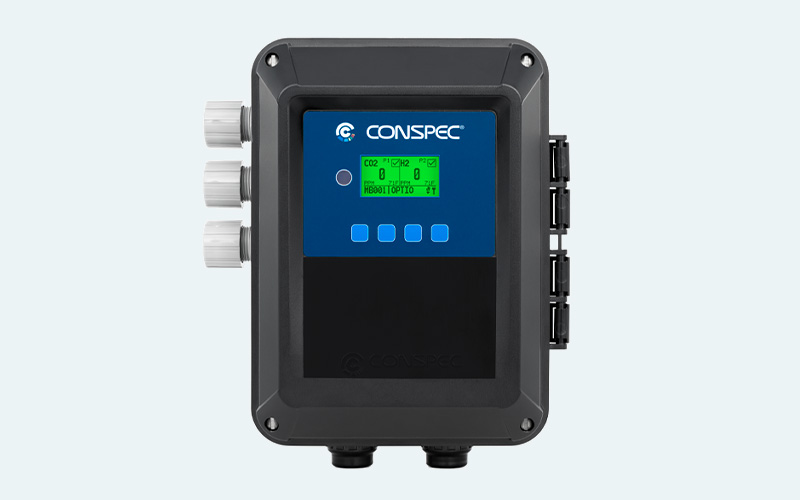
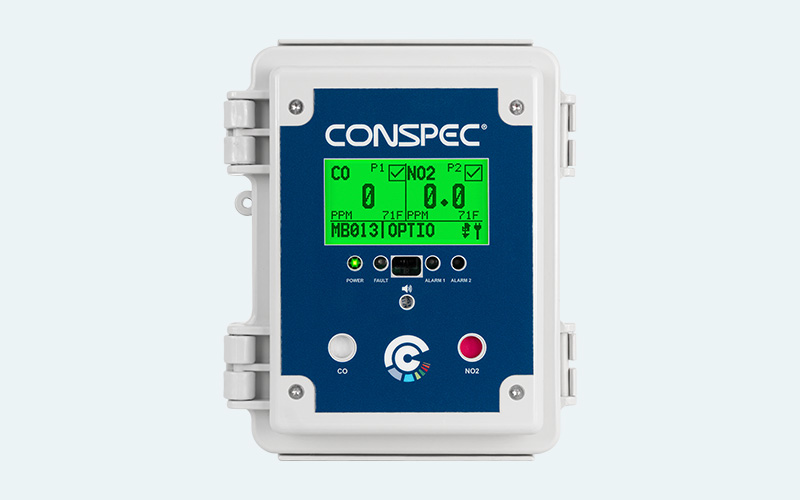
Gas detection systems play a critical role in protecting personnel, equipment, facilities, and processes from hazardous or combustible gases. But not all gas sensors work the same way. Different sensor technologies use different physical or chemical principles to detect specific gases and determine their concentration.
Understanding how these technologies work can help safety professionals and system designers select the right detection technology for a particular application.
Four commonly used technologies are non-dispersive infrared (NDIR), electrochemical, photoionization detection (PID), and pellistor / catalytic bead sensors. Each operates differently and is suited to detecting different types of gases.
NDIR, or non-dispersive infrared, sensors detect gases by measuring the absorption of infrared light. The technology relies on the fact that certain gases absorb infrared light at specific wavelengths. By measuring how much infrared light is absorbed, the sensor can determine the concentration of the target gas.
Because NDIR sensors rely on optical absorption rather than a chemical reaction, they provide a useful approach for applications where reliable measurement of specific gases is required.
Electrochemical sensors detect gases through chemical reactions that generate an electrical signal. When the target gas reaches the sensor, it diffuses through a membrane and reacts at the working electrode. This reaction produces a flow of electrons, creating an electrical current that corresponds to the concentration of the target gas.
Electrochemical technology is particularly useful when detecting gases that can be measured through a specific chemical reaction.
PID, or photoionization detection, sensors use ultraviolet (UV) light to ionize gas molecules. When certain target gases, including volatile organic compounds (VOCs), enter the sensor, UV light ionizes the molecules, creating positively charged ions and free electrons. The resulting electrical current can then be measured to determine the concentration of the gas.
Because PID technology uses photoionization to detect gases, it is particularly applicable to monitoring VOCs and other gases that can be ionized by the sensor’s UV source.
Pellistor sensors, also known as catalytic bead sensors, are commonly used for detecting combustible gases. The technology uses a small bead made from catalytic material. The catalyst enables a reaction to occur at a lower ignition temperature. A heater is used to burn the combustible gas, generating heat that changes the electrical resistance of the bead.
Pellistor technology has long been used for combustible gas detection because it translates the heat produced by the catalytic reaction into a measurable electrical signal.
Each sensor technology has advantages and limitations. The right choice depends on the target gas, concentration range, environmental conditions, maintenance requirements, and overall gas detection strategy.
| Sensor Technology | Potential Pros | Potential Cons |
|---|---|---|
| NDIR |
| Gas limitations; not all gases absorb infrared light strongly enough to be measured effectively using NDIR technology. Potential optical contamination; dust, moisture, or other contaminants may affect optical components depending on the sensor design and environment. Higher initial cost; can be more expensive than some alternative sensor technologies. |
| Electrochemical | High sensitivity; well suited for detecting many toxic gases at relatively low concentrations. Compact design; can be incorporated into a wide range of portable and fixed gas detection instruments. Lower power requirements; typically requires less power than sensor technologies that use a heated element or light source. | Limited sensor life; the chemical components within the sensor can degrade over time. Environmental sensitivity; temperature and humidity can affect sensor performance. Cross-sensitivity; some sensors may respond to gases other than the intended target gas. |
| PID | High sensitivity for VOCs; capable of detecting many volatile organic compounds at low concentrations. Fast response; can provide rapid indication of changing VOC concentrations. Broad detection capability; can respond to a range of ionizable compounds. | Limited selectivity; a PID may respond to multiple compounds, making it difficult to identify a specific gas without additional information. Maintenance requirements; UV lamps and sensor components require periodic cleaning and maintenance. Gas limitations; only detects compounds that can be ionized by the UV energy used by the sensor. |
| Pellistor (Catalytic Bead) | Established technology; widely used for combustible gas detection. Effective for flammable gas monitoring; capable of detecting many combustible gases and vapors. Proven approach; has a long history of use in industrial gas detection applications. | Requires oxygen; combustible gas detection depends on sufficient oxygen being available to support the reaction. Potential sensor poisoning or inhibition; certain contaminants can reduce sensor performance or damage the catalytic element. Power consumption; the heated sensing element generally requires more power than some alternative technologies. |
There is no single sensor technology that is ideal for every gas detection application. The appropriate technology depends on the gas being monitored, the operating environment, the required detection range, and the objectives of the safety system.
Understanding these technologies and their fundamental differences is an important first step when designing or evaluating a fixed gas detection system. The right sensor technology helps ensure that a detection system is properly matched to the hazards it is intended to monitor.
For applications involving hazardous, combustible, or toxic gases, working with an experienced gas detection manufacturer can help ensure the sensor technology, system configuration, and monitoring strategy are appropriate for the application. ∎
Not sure which sensor technology is right for your gas detection application? Conspec’s safety experts are here to help; schedule a free consultation.